Email Marketing Strategies That Help Businesses Build Long-Term Customer Relationships
Introduction
Email marketing remains one of the most effective digital marketing strategies for businesses that want to build strong, long-term relationships with their customers. While social media and paid advertising are useful for attracting attention, email marketing gives businesses a direct communication channel with people who have already shown interest in their products, services, or brand.
A successful email marketing strategy is not simply about sending promotional messages. It is about delivering the right message at the right time. Businesses can use email to educate customers, share valuable information, introduce new products, provide personalized recommendations, collect feedback, and maintain regular communication.
1. Build a High-Quality Email Subscriber List
The foundation of successful email marketing is a high-quality subscriber list. Businesses should focus on attracting people who genuinely want to receive their communications rather than collecting random email addresses.
A quality email list can be built through website signup forms, newsletter subscriptions, product registrations, free resources, online events, contact forms, and special offers.
For example, an online clothing business could offer a small discount to visitors who subscribe to its newsletter. A digital marketing agency could provide a free SEO checklist in exchange for an email address.
The important point is to make the value of subscribing clear. Customers should understand what they will receive after joining the email list.
Businesses should also avoid purchasing email lists. Purchased lists often contain irrelevant or inactive users and can negatively affect email engagement and sender reputation.
2. Understand Your Target Audience
Effective email marketing starts with understanding the audience. Every customer has different interests, needs, challenges, and buying motivations.
Businesses should collect useful information about their audience and use it to create more relevant email campaigns. Important information may include customer interests, previous purchases, location, browsing behavior, preferred products, and engagement with previous emails.
For example, a customer who frequently purchases sportswear should not receive the same email as someone interested in formal clothing.
Understanding the audience helps businesses move from generic communication toward personalized customer experiences.
3. Segment Your Email List
Email segmentation allows businesses to divide their subscribers into smaller groups based on shared characteristics or behavior.
Instead of sending the same email to everyone, marketers can create specific campaigns for different customer segments.
Common segmentation methods include:
-
- New subscribers
-
- Existing customers
-
- Repeat customers
-
- Inactive subscribers
-
- Customers based on location
-
- Customers based on interests
-
- Customers based on purchase history
-
- High-value customers
-
- Customers who abandoned their shopping cart
For example, an e-commerce company can send product recommendations based on previous purchases. A local business can send location-specific offers to customers in a particular city.
Segmentation improves relevance and can lead to better engagement because customers receive content that is more closely connected to their needs.
4. Personalize Email Communication
Personalization is one of the most important strategies for building customer relationships through email marketing.
Instead of sending a completely generic message, businesses can personalize emails using customer names, interests, purchase history, preferences, and behavior.
For example, instead of saying:
“Check out our latest products.”
A business could say:
“Hi Rahul, here are some new products we think you may like based on your previous purchases.”
Personalization can make communication feel more relevant and customer-focused.
However, personalization should go beyond simply adding a customer’s first name. Businesses can personalize product recommendations, offers, content, and timing based on customer behavior.
5. Send Valuable Content, Not Only Promotions
One of the biggest mistakes businesses make with email marketing is sending promotional messages too frequently.
If every email asks customers to purchase something, subscribers may lose interest or unsubscribe.
A better approach is to provide a balance between promotional and educational content.
Businesses can send:
-
- Helpful tips
-
- Industry insights
-
- How-to guides
-
- Educational articles
-
- Product usage tips
-
- Customer success stories
-
- Company updates
-
- Exclusive content
-
- Frequently asked questions
-
- Special offers
For example, a digital marketing company can send subscribers useful SEO tips, content marketing ideas, social media strategies, and website optimization advice.
When emails consistently provide value, customers have a stronger reason to remain subscribed.
6. Create a Strong Welcome Email Series
The first few emails a customer receives can strongly influence their relationship with a brand.
A welcome email series can introduce new subscribers to the company, explain what they can expect, and provide useful information.
A simple welcome sequence could include:
Email 1: Welcome and introduction
Email 2: Brand story and values
Email 3: Helpful resources or popular products
Email 4: Customer reviews or success stories
Email 5: Special offer or next step
This sequence allows businesses to build familiarity gradually rather than immediately pushing for a sale.
A good welcome series can help turn new subscribers into engaged customers.
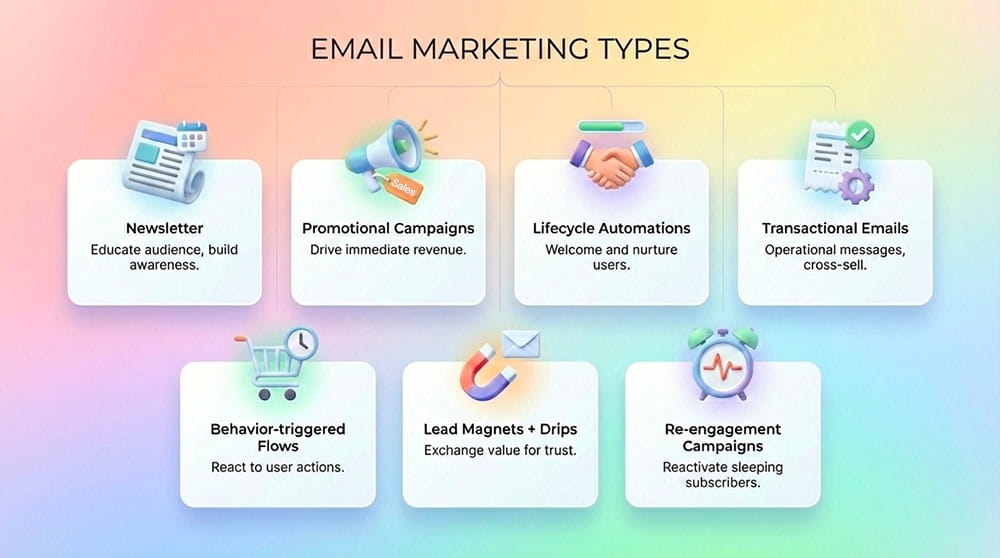
7. Use Automated Email Campaigns
Email automation helps businesses communicate with customers at important moments without manually sending every email.
Automated campaigns can be triggered by specific customer actions.
Examples include:
-
- Welcome emails
-
- Abandoned cart emails
-
- Birthday emails
-
- Purchase confirmations
-
- Product recommendation emails
-
- Review requests
-
- Re-engagement campaigns
-
- Renewal reminders
-
- Follow-up emails
For example, if a customer adds a product to their cart but does not complete the purchase, an automated reminder can encourage them to return.
Automation saves time while allowing businesses to maintain consistent communication with customers.
8. Develop an Abandoned Cart Email Strategy
Abandoned cart emails are particularly useful for e-commerce businesses.
Customers may add products to their cart but leave the website because of distractions, pricing concerns, technical issues, or simply because they are not ready to purchase.
A carefully designed abandoned cart email can remind them about the product.
A good sequence could include:
First reminder: Friendly reminder about the product.
Second reminder: Highlight product benefits, reviews, or frequently asked questions.
Final reminder: Offer a limited incentive if appropriate.
The messaging should remain helpful rather than aggressive. Businesses should avoid making customers feel pressured.
9. Reward Loyal Customers
Customer retention is often more valuable than constantly acquiring new customers.
Email marketing can help businesses recognize and reward loyal customers.
Businesses can provide:
-
- Exclusive discounts
-
- Early access to products
-
- Loyalty rewards
-
- Special event invitations
-
- Members-only content
-
- Personalized recommendations
-
- Birthday offers
-
- Referral rewards
For example, a fashion brand could give frequent customers early access to a new collection.
When customers feel appreciated, they are more likely to continue engaging with the brand.
10. Use Customer Feedback Emails
Building a long-term relationship requires two-way communication.
Businesses should not only send information to customers; they should also ask customers what they think.
Feedback emails can ask customers about:
-
- Product satisfaction
-
- Customer service experience
-
- Website experience
-
- New product ideas
-
- Content preferences
-
- Areas for improvement
For example:
“How was your recent experience with us?”
Simple questions like this can provide valuable insights while showing customers that their opinions matter.
Customer feedback can also help businesses improve products and services.
11. Create Re-Engagement Campaigns
Some subscribers may stop opening emails after a period of time. Instead of immediately removing them from the list, businesses can create a re-engagement campaign.
A re-engagement email might say:
“We miss you. Here are some updates you may have missed.”
Businesses can provide useful content, personalized recommendations, or a special incentive to encourage inactive subscribers to return.
If subscribers remain inactive, businesses should consider removing them from regular campaigns. Maintaining a clean email list can improve overall engagement and email deliverability.
12. Write Attention-Grabbing Subject Lines
The subject line is one of the first things a subscriber sees.
A strong subject line should be clear, relevant, and interesting without being misleading.
Examples include:
-
- “5 Simple Ways to Improve Your Website”
-
- “Your Exclusive Offer Is Waiting”
-
- “New Arrivals You May Love”
-
- “What’s New This Month?”
-
- “Your Guide to Better Digital Marketing”
Businesses should avoid excessive capitalization, misleading claims, or overly aggressive language.
The goal is to create curiosity while accurately representing the content inside the email.
13. Optimize Emails for Mobile Devices
Many customers read emails on smartphones and tablets. Therefore, businesses need to ensure that emails are mobile-friendly.
A mobile-friendly email should have:
-
- Clear fonts
-
- Short paragraphs
-
- Easy-to-click buttons
-
- Responsive design
-
- Simple layouts
-
- Properly optimized images
If an email is difficult to read or interact with on a smartphone, customers may ignore it.
Mobile optimization is therefore an essential part of modern email marketing.
14. Use Clear Calls to Action
Every marketing email should have a clear purpose.
The call to action tells the customer what to do next.
Examples include:
-
- Shop Now
-
- Learn More
-
- Read the Guide
-
- Book a Consultation
-
- Download the Resource
-
- Explore Products
-
- Get Started
Businesses should avoid filling one email with too many competing calls to action.
A focused email makes it easier for customers to understand the desired next step.
15. Maintain a Consistent Email Schedule
Consistency helps businesses remain recognizable without overwhelming subscribers.
Sending emails too frequently can cause fatigue, while sending them too rarely can make customers forget the brand.
The ideal frequency depends on the business and audience.
For example, a newsletter-based business might send one useful email per week, while an e-commerce company may communicate more frequently during product launches or seasonal campaigns.
Businesses should monitor engagement and adjust frequency based on customer behavior.
16. Use Storytelling to Build Emotional Connections
Customers often connect with stories more strongly than with direct sales messages.
Businesses can use email marketing to share stories about their brand, employees, customers, products, or journey.
For example, a small business could explain how it started, the challenges it faced, and how its products help customers.
Customer success stories are also powerful because they show real-world results.
Storytelling makes email communication more human and can strengthen emotional connections between customers and brands.
17. Use Customer Testimonials and Reviews
Social proof can help build trust.
Businesses can include customer reviews, testimonials, ratings, case studies, and success stories in email campaigns.
For example, an email promoting a service could include a short customer testimonial explaining how the service solved a specific problem.
Real customer experiences can make promotional emails more credible and help potential customers feel more confident about the brand.
18. Test Different Email Strategies
Email marketing should be treated as an ongoing optimization process.
Businesses can use A/B testing to compare different versions of an email.
They can test:
-
- Subject lines
-
- Headlines
-
- Images
-
- CTA buttons
-
- Email layouts
-
- Content length
-
- Sending times
-
- Offers
For example, one group of subscribers might receive the subject line “10 SEO Tips for Small Businesses,” while another group receives “Improve Your Local SEO With These 10 Tips.”
The results can help marketers understand what type of messaging performs better.
19. Track Important Email Marketing Metrics
Businesses need data to understand whether their email marketing strategy is working.
Important metrics include:
Open Rate
Shows how many recipients opened the email. It can provide insights into subject-line effectiveness and audience engagement.
Click-Through Rate
Measures how many subscribers clicked links or buttons inside the email.
Conversion Rate
Shows how many recipients completed a desired action, such as purchasing a product or submitting a form.
Unsubscribe Rate
Shows how many subscribers opted out of future emails.
Bounce Rate
Indicates how many emails could not be successfully delivered.
Revenue Per Email
For e-commerce and sales-focused campaigns, this can help measure the financial contribution of email marketing.
Tracking these metrics allows businesses to identify strengths and improve weak areas.
20. Respect Customer Privacy and Preferences
Long-term customer relationships depend on trust.
Businesses should clearly explain why they collect email addresses and what subscribers can expect.
Customers should have an easy way to unsubscribe or manage their email preferences.
Businesses should also follow applicable privacy and email marketing regulations.
Respecting customer preferences helps protect brand reputation and creates a more trustworthy relationship.
21. Create Seasonal and Event-Based Campaigns
Seasonal email campaigns can provide opportunities to engage customers with timely content.
Businesses can create campaigns around:
-
- New Year
-
- Valentine’s Day
-
- Summer sales
-
- Back-to-school periods
-
- Festival seasons
-
- Holiday shopping
-
- Business anniversaries
-
- Product launches
However, seasonal marketing should remain relevant to the audience. Businesses should avoid sending unnecessary promotional emails simply because an event is taking place.
22. Build a Customer Journey Through Email
Instead of treating each email as an individual campaign, businesses should consider the complete customer journey.
A typical journey may look like:
Visitor → Subscriber → New Customer → Repeat Customer → Loyal Customer → Brand Advocate
Email can support every stage.
New subscribers can receive educational content. New customers can receive onboarding emails. Existing customers can receive recommendations. Loyal customers can receive exclusive rewards. Happy customers can be encouraged to leave reviews or refer friends.
This approach turns email marketing into a long-term relationship-building system rather than a simple promotional channel.
23. Combine Email Marketing With Other Digital Marketing Channels
Email marketing becomes even more powerful when integrated with other marketing channels.
Businesses can connect email campaigns with:
-
- SEO
-
- Social media marketing
-
- Content marketing
-
- Paid advertising
-
- Google Ads
-
- Influencer marketing
-
- Website marketing
-
- Remarketing
For example, a business can publish a detailed blog article and send the article to its email subscribers. Social media followers can also be encouraged to subscribe to the newsletter.
This creates multiple touchpoints between customers and the brand.
24. Make Every Email Feel Human
Automation and personalization are valuable, but emails should still feel human.
Businesses should use simple language, clear messaging, and a conversational tone.
Instead of making an email sound like a corporate announcement, marketers can write as though they are communicating directly with a customer.
Human-centered communication can make customers feel more comfortable and connected to the brand.
25. Focus on Long-Term Customer Value
The ultimate goal of email marketing should not always be immediate sales.
Businesses should focus on customer lifetime value.
A customer who makes one purchase is valuable, but a customer who continues purchasing, recommends the brand to others, leaves positive reviews, and remains engaged for years can be significantly more valuable.
Email marketing helps maintain this relationship by providing regular value and staying connected throughout the customer lifecycle.
Benefits of a Strong Email Marketing Strategy
A well-planned email marketing strategy can provide several long-term benefits for businesses.
Increased Customer Retention
Regular and valuable communication keeps customers connected with the brand.
Stronger Brand Awareness
Consistent emails help customers remember the business.
Higher Customer Engagement
Personalized and useful content encourages subscribers to interact with the brand.
Better Customer Loyalty
Exclusive content, rewards, and personalized experiences can strengthen loyalty.
More Repeat Purchases
Product recommendations, follow-ups, and targeted offers can encourage customers to return.
Improved Customer Understanding
Email analytics and feedback can provide valuable information about customer preferences.
Cost-Effective Marketing
Compared with many traditional marketing methods, email marketing can be a cost-effective way to communicate with an existing audience.
Common Email Marketing Mistakes to Avoid
Businesses should also understand what can damage their email marketing performance.
Some common mistakes include:
-
- Sending too many promotional emails
-
- Buying email lists
-
- Using misleading subject lines
-
- Ignoring mobile users
-
- Sending irrelevant content
-
- Not segmenting the audience
-
- Failing to personalize communication
-
- Using unclear calls to action
-
- Ignoring customer feedback
-
- Not monitoring email performance
-
- Making unsubscribe options difficult to find
Avoiding these mistakes can improve customer trust and campaign effectiveness.
Conclusion
Email marketing is much more than a tool for promoting products and services. When used strategically, it becomes a powerful way for businesses to communicate with customers, provide value, understand their preferences, and build long-term relationships.
The most successful email strategies focus on relevance, personalization, consistency, and customer value. Businesses should build quality subscriber lists, segment their audiences, provide useful content, automate important communications, reward loyal customers, collect feedback, and continuously analyze campaign performance.
The key is to think beyond individual email campaigns and focus on the complete customer journey. Every email should contribute to a positive experience with the brand.
When businesses consistently deliver helpful and relevant communication, customers are more likely to trust the brand, remain engaged, make repeat purchases, and recommend it to others.
In the long run, effective email marketing is not just about getting customers to buy—it is about giving them reasons to stay.
Pingback: How GrowthSiddhi Helps Businesses Grow with Digital Marketing - Growvexa